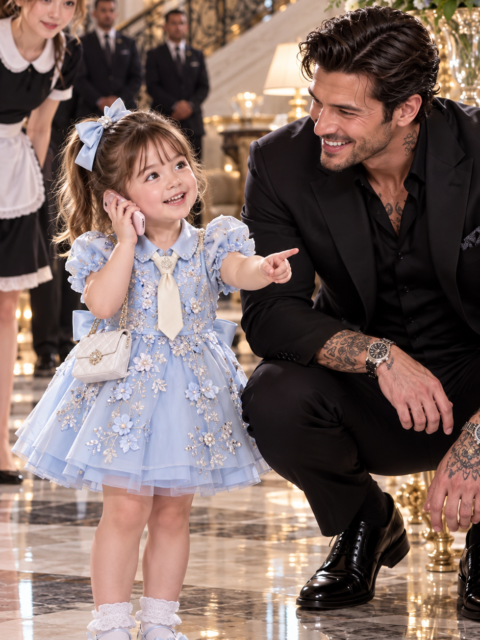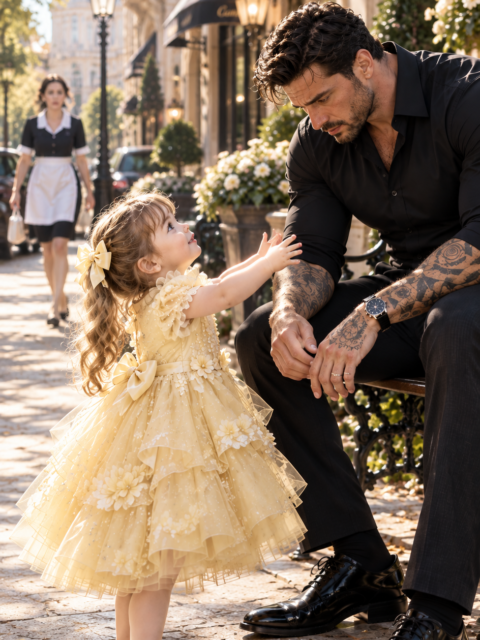
“Would You Like to Dance With Me?”
At 9:47 p.m., nine-year-old Leo Moretti covered his ears behind a marble pillar as cruel guests laughed at his distress. Then Clara Bennett—a hired pianist who had been warned never to draw Don Dante Moretti’s attention—stopped playing mid-waltz, walked across the ballroom, and changed the ruthless boss’s empire forever.
Chapter 1: The Piano That Stopped at 9:47 PM Part I
“DO YOU EVEN KNOW HOW TO DANCE, FREAK?”
The cruel mockery cut through the swell of the string quartet at 9:47 p.m., and my fingers tightened around my crystal scotch glass until my knuckles turned white. At thirty-four, I was the youngest boss the Moretti family had ever produced. Men across New York’s five boroughs lowered their voices when they spoke my name because they knew I never shouted; I simply made a phone call, and problems ceased to exist. I wore a black bespoke suit without a tie, a platinum wedding band still circling my left ring finger for a wife I had buried three years ago. Tonight was my cousin Luca’s wedding—a cathedral of white roses, gold light, and three hundred guests who smiled like knives—and I wasn’t watching the bride.
I was watching my nine-year-old son, Leo.
He stood half-hidden behind a fluted marble pillar near the edge of the dance floor, looking impossibly small in a tailored suit he hated. Both of his hands were pressed over his ears—not dramatically, just tightly enough to survive the crashing trays, the braying laughter, and the suffocating perfume of people who treated his silence like a contagious disease. In his right fist, he clutched his small brass train car.
Across from him, Capo Vittorio’s fourteen-year-old nephew bowed with exaggerated, theatrical cruelty while two other boys in tuxedos snickered behind their hands. Near the terrace, Vittorio himself muttered loudly over his champagne that defective children belonged locked upstairs. Leo flinched, his shoulders climbing toward his jaw, his gray eyes darting toward the exits.
I took one step away from the head table, ready to turn my cousin’s wedding into a funeral. Then the piano stopped.
It didn’t fade out. The waltz simply died mid-measure, leaving a silence so sharp that every head in the ballroom snapped toward the white Steinway grand beneath the star-shaped chandelier. The agency manager by the wall went pale, shaking her clipboard in frantic warning, but the young woman on the piano bench didn’t look at her.
She stood up.
She wore a soft periwinkle-blue dress that moved gently around her legs—not silk designed to show off wealth, but fabric chosen because it didn’t rustle or scratch. She didn’t hurry. She walked past the champagne tower, past my armed capos who watched her with cold calculation, keeping her chin level and her hands loose at her sides until the entire room’s focus gathered on her like static electricity.
My eyes locked onto her. The air in the ballroom dropped ten degrees, yet she didn’t even glance at me.
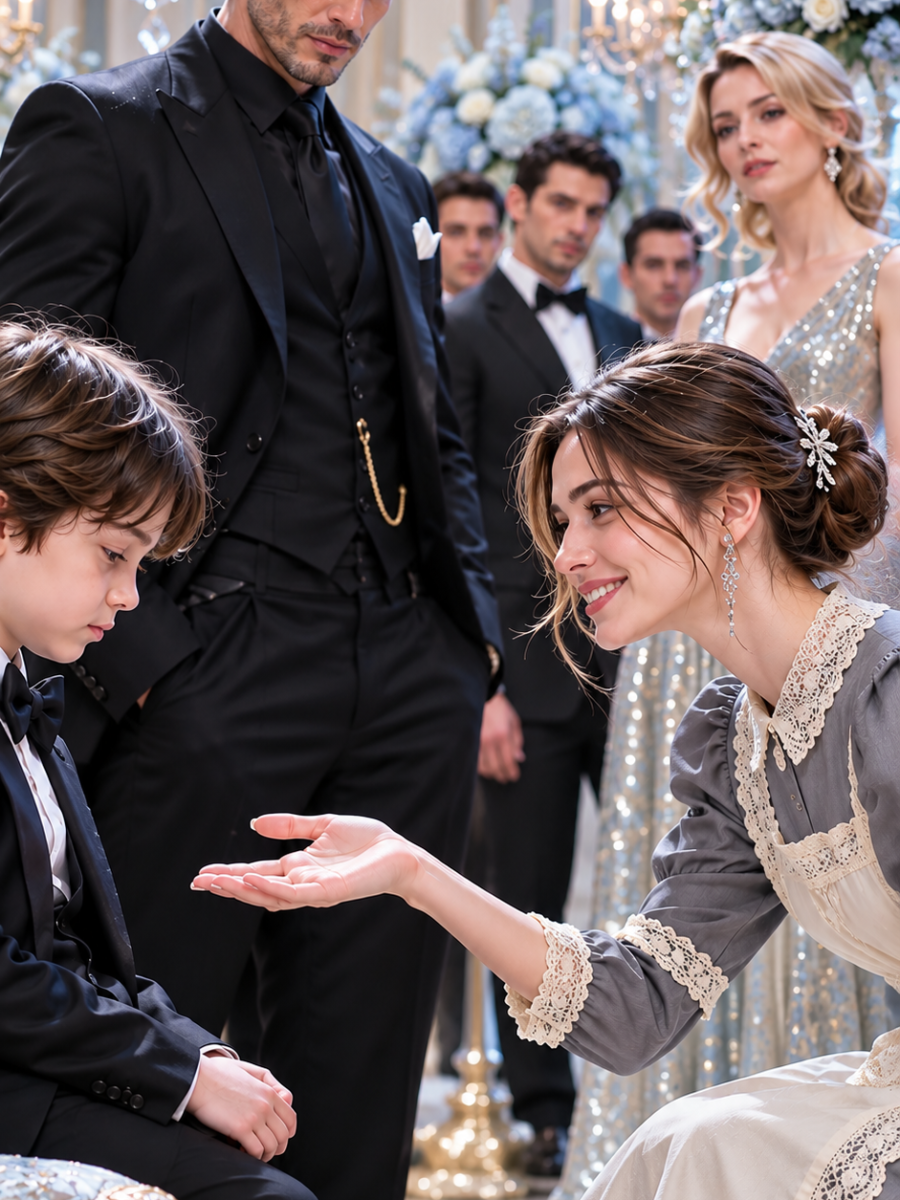
She stopped four feet in front of my son—close enough to shield him from the tuxedo boys, far enough not to crowd his space. She didn’t crouch down in that patronizing way adults use when they perform sympathy. Instead, she softened her voice to a steady, quiet register that cut right through the static in Leo’s head.
“Hi, Leo,” she said. “My name is Clara.”
Leo’s hands stayed over his ears. His guarded gray eyes flicked to her face, away to her shoes, and back again. She waited without demanding anything from him.
Then she offered a small, calm smile that silenced three hundred killers and socialites alike: “Would you like to dance with me?”
↑ Back to Top
Chapter 2: Fifty Percent of the Moretti Empire Part II
FOR THREE FULL SECONDS, NOBODY IN THE BALLROOM BREATHED. The bride’s white roses trembled in her hands. The tuxedo boy who had called my son a freak took a stumbling step backward, his face draining of blood as he realized I was standing ten feet away, staring a hole through his skull.
“I don’t like the violins,” Leo whispered. It was the first sentence he had spoken outside our home in eight months. His voice was barely audible, raspy from disuse, yet Clara heard every syllable.
“Neither do I,” Clara replied conversationally, as if they were the only two people in Manhattan. “They’re too sharp on the high notes. Do you know what sounds much better? A four-four locomotive rhythm. Just like the Hudson Line.”
Leo’s fingers loosened slightly over his ears. He looked down at the brass train car in his fist, then up at her eyes. “Four-four time?”
“Four beats to a track,” she said softly. She didn’t reach out to grab his hand—she knew touch was a boundary he had to cross himself. Instead, she tapped her soft leather shoe four times against the parquet floor. Tap-tap-tap-tap. Steady. Low. Predictable. “One, two, three, four. We don’t even have to touch. We just move when the train moves.”
Slowly, miraculously, my son lowered both hands from his ears. He slid his left palm into her open hand, his fingers still curled around the brass train car. Clara swayed one step to the left. Leo mirrored her. One step to the right. No music played, yet in the middle of that gilded hall of vipers, they danced to a silent rhythm only the two of them could hear.
Then the agency manager rushed forward, her heels clicking frantically as Capo Vittorio stepped out from the terrace with a scowl.
“Get this crazy girl out of here!” the manager hissed, grabbing Clara’s elbow. “Mr. Moretti, I am so sorry! She was explicitly instructed not to speak to the family! You’re fired, Clara! Get your coat and get out!”
Capo Vittorio sneered, waving a thick hand. “Send the boy upstairs with the nanny, Dante. We have guests from Chicago watching.”
Leo stiffened, his hand tightening on Clara’s fingers. I walked forward until I stood directly beside them. I didn’t look at the manager. I picked up a silver butter knife from the nearest banquet table and tapped it three times against my crystal glass. Clink. Clink. Clink.
The sharp ring froze every person in the room.
“For seven years,” I said, my quiet voice carrying to the farthest corner of the cathedral ceiling, “this family and this room have treated my son like a ghost you were embarrassed to look at. You whispered behind your champagne glasses while a nine-year-old boy drowned in your noise.”
I placed my hand gently on the back of Leo’s head, then pointed to Clara Bennett, who stood trembling in her secondhand blue dress, still refusing to let go of my son’s hand.
“Tonight, the only person in this building with a spine and a heart walked across this floor,” I announced, staring straight into Capo Vittorio’s pale face. “Effective midnight, the Moretti family is pulling every shipping contract out of Vittorio’s Brooklyn terminals. And fifty percent of the Moretti Charitable Shipping Trust now belongs to the woman holding my son’s hand.”
I turned to the agency manager, whose clipboard clattered to the marble floor: “Touch her arm again, and I’ll buy your building just to board up the doors. Marco—bring my car around.”
↑ Back to Top
Chapter 3: The Clanking Radiator and Ward 4B Part III
CLARA REFUSED THE MONEY THAT NIGHT. When I walked her and Leo out to the private portico while three hundred guests stared at the floor in terrified silence, she knelt gently to return Leo’s hand, gave him a soft four-beat tap on his wrist, and looked up at me with steady hazel eyes.
“I didn’t ask him to dance for your shipping empire, Mr. Moretti,” she said, her voice shaking slightly in the cool night air even as her chin stayed level. “I asked him because nine-year-old boys shouldn’t have to hold their ears at a party. Keep your fifty percent. Just buy him a pair of acoustic-filtering earbuds and stop forcing him into rooms that hurt him.”
Before my guards could block her, she walked down the granite steps and disappeared into the subway entrance on Lexington Avenue.
In the back of my armored Maybach, Leo sat beside me without covering his ears. He rolled the brass train car across his knee, looked up at my face—something he hadn’t done in weeks—and whispered: “Clara knows the Hudson Line, Papa.”
My chest ached with a fierceness that nearly stole my breath. “Marco,” I said to my head of security in the front passenger seat. “I want her file in thirty minutes.”
It took Marco nineteen. By the time Leo was asleep in his penthouse bedroom, Marco laid a thin folder on my desk. Clara Bennett, twenty-four. One semester short of a Master’s in Music Therapy at NYU before her mother died of pancreatic cancer. She lived in a fourth-floor walk-up in Queens with a clanking radiator and four months of past-due rent notices. Every dime she earned playing society weddings went directly to Mount Sinai’s Pediatric Renal Ward—Room 412—where her fifteen-year-old sister Mia was on dialysis six days a week, waiting at the bottom of a regional kidney transplant list.
I didn’t wait until morning. At 11:30 p.m., I walked down the quiet, antiseptic corridor of Mount Sinai’s fourth floor with two guards stationed at the elevators.
Through the glass window of Room 412, I saw Clara sitting in a vinyl recliner beside a hospital bed, still wearing her blue wedding dress under a frayed cardigan. A teenage girl with dark circles under her eyes was laughing weakly as Clara made up a song about hospital Jell-O.
I knocked once and stepped inside. Clara shot to her feet, stepping instinctively in front of her sister’s bed like a lioness guarding her cub. “What are you doing here? How did you find us?”
“So this is the scary wedding boss?” Mia piped up from the pillows, squinting at my black suit. “Clara said you looked like a statue with anger issues. Personally, I think it’s the eyebrows.”
Clara closed her eyes in sheer mortification. “Mia, please stop talking.”
For the first time in three years, the corner of my mouth twitched. I pulled a folded document from my breast pocket and laid it on the bedside table. “Dr. David Vance, the Chief of Pediatric Nephrology at Johns Hopkins, lands at Teterboro in four hours. Your sister’s hospital debt is cleared, her transplant evaluation is moved to priority status tomorrow morning, and your NYU tuition balance is paid in full.”
Clara stared at the stamped hospital clearance, her breath catching. “Why? I told you I don’t want charity—”
“It isn’t charity, Miss Bennett,” I said quietly, meeting her tear-filled eyes. “My son hasn’t spoken a full sentence since his mother died three years ago. Tonight he asked for you by name. Come work for me—and name your price.”
↑ Back to Top
Chapter 4: The Brass Train Car and the Music Box Part IV
CLARA MOVED INTO THE EAST WING OF MY MANHATTAN ESTATE two days later, after Mia was transferred into a private luxury suite at the hospital with round-the-clock nursing care. Within forty-eight hours, Clara changed rules in my house that I hadn’t realized were hurting my son.
She had the ticking grandfather clocks in the hallways silenced. She replaced the harsh halogen bulbs in the study with warm amber lamps. She never forced Leo to sit still at the white grand piano in the conservatory; instead, she let him lie underneath the soundboard on a thick wool rug with his brass train car while she played low, rhythmic chords that vibrated through the cedar wood into his chest.
On thefifth afternoon, I came home early from the docks and stood outside the conservatory doors. Clara was playing a gentle, rolling melody in four-four time. Beneath the piano, Leo wasn’t hiding. He was sitting up on his knees, rolling his brass train car along the edge of the bench right beside her left hand.
“Where does this train go, Leo?” Clara asked softly over the keys.
“Cold Spring,” Leo answered clearly. “Mama’s house by the river. Before the brakes broke.”
I froze in the doorway. My heart hammered against my ribs. Three years ago, my wife Elena had died when her Mercedes plunged down the steep ravine outside our Cold Spring country house during a rainstorm. Leo had been six years old, strapped into the rear safety seat. He had survived with minor bruises, but he had never spoken a single word about that afternoon. The police and my own mechanics had ruled it a master-cylinder failure caused by corrosion.
Clara kept her fingers moving in the exact same soothing tempo so she wouldn’t startle him. “Did Mama give you the brass train?”
“No,” Leo said, lifting the heavy little metal car. “It was inside the secret bottom of her cello case. Wait.” Leo stood up, walked over to the mahogany bookshelf in the corner of the conservatory, and pulled down Elena’s old cherrywood metronome—an object none of the maids were allowed to touch. He twisted the brass pendulum weight counterclockwise three times.
A hidden drawer clicked open at the base of the metronome. Inside lay a tiny silver digital voice recorder that Elena used to record her melody drafts.
I stepped into the room, my throat dry. “Leo… how long have you known that was in there?”
Leo looked at me, then reached out and held Clara’s skirt for courage. “Since the rain day, Papa. I hid it because the man at the wedding was whistling the song.”
Clara and I exchanged a chilling look. “What song, Leo?” I whispered, kneeling slowly beside him.
Leo handed me the silver recorder with trembling fingers: “The song the man whistled under Mama’s car right before we drove down the hill.”
↑ Back to Top
Chapter 5: The Tarantella on the Recording Part V
MY THUMB SHOOK AS I PRESSED PLAY on the tiny silver voice recorder. For the first ten seconds, there was only the sound of Elena’s soft voice humming a lullaby in the garage of our Cold Spring estate, dated October 14th—twenty minutes before her car went over the cliff. Then Elena’s footsteps faded as she went back inside the house to grab Leo’s raincoat, leaving the recorder running on the garage workbench.
In the background of the recording, heavy footsteps crunched on the gravel driveway. The metallic clink of a hydraulic line wrench echoed against the underside of the chassis. And over the hiss of leaking brake fluid came a low, unmistakable whistling—an old Sicilian tarantella with a sharp, syncopated trill on the third bar.
Then a gruff voice spoke into a phone on the tape: “The fluid reservoir is drained, Don Vittorio. She’s taking the mountain road in five minutes. Once Dante’s wife is gone, he’ll be too broken to block the Red Hook merger.”
The recording clicked off.
The blood in my veins turned to liquid fire. Capo Vittorio. My father’s oldest friend. The man who had stood beside me at Elena’s grave in the pouring rain, patting my shoulder while my six-year-old son stared in mute terror at his shoes.
Leo hadn’t gone silent because the crash broke his mind. He had gone silent because for three years, the monster who murdered his mother sat at our family holiday dinners, whistling that same Sicilian tarantella over cigars, and my little boy was terrified that if he spoke, the monster would take me too.
“That was why he covered his ears at the wedding,” Clara whispered, her face pale with horror as she gathered Leo gently into her arms. “It wasn’t just the loud quartet, Dante. When Vittorio walked past the pillar near the terrace, he was whistling that tune.”
Leo buried his face into Clara’s periwinkle shoulder, his small body shaking with three years of locked-up grief. “I didn’t want him to take Papa’s brakes,” Leo sobbed aloud, his tears soaking her dress. “I tried to be invisible so he wouldn’t see me.”
I dropped to my knees, wrapping my arms around both my son and the woman who had finally given him a safe place to speak. For the first time since the coffin went into the earth, a hot tear spilled down my scarred cheek. “You don’t ever have to be invisible again, Leo,” I swore against his dark hair. “Papa sees you. And that man will never come near this family again.”
Suddenly, my encrypted phone vibrated on the piano lid. It was Marco, stationed with the security detail at Mount Sinai Hospital.
“Boss!” Marco’s voice barked over the sound of shattering glass. “Vittorio’s hitmen just breached the fourth-floor service elevator at Mount Sinai—they’re heading straight for Mia’s room!”
↑ Back to Top
Chapter 6: Ambush at the Pediatric Wing Part VI
CLARA’S FACE DRAINED OF COLOR. “Mia! She’s hooked up to the dialysis machine—she can’t run!”
“Marco has four of my best men outside her door, Clara,” I said, my voice dropping into the lethal, ice-cold register that New York’s underworld feared above all else. “When I stripped Vittorio’s Brooklyn port contracts at the wedding and put your name on the trust, he started digging into why you reached Leo. He figured out Leo was talking.”
I locked Clara and Leo inside the estate’s subterranean titanium panic room under the guard of twelve heavily armed soldiers, kissed my son’s forehead, and looked Clara dead in the eye. “I will bring your sister out untouched. On my life.”
Three black armored Suburban SUVs tore down the FDR Drive at ninety-five miles an hour, sirens screaming as my NYPD precinct contacts cleared every intersection between Midtown and Upper Manhattan. Inside the lead truck, I checked the chamber of my suppressed Heckler & Koch USP .45.
We hit the Mount Sinai ambulance bay in eleven minutes flat. Taking the emergency stairwell three steps at a time with six tactical enforcers behind me, I breached the fourth-floor fire doors just as two of Vittorio’s hired gunmen in stolen hospital scrubs were trying to force their way past Marco’s barricade outside Room 412.
I didn’t give them a warning. Two suppressed rounds took the rear gunman in the right knee and shoulder, dropping him to the linoleum with a muffled shriek. I closed the distance in three long strides, caught the lead shooter’s pistol barrel in my left hand, twisted his wrist until the bone snapped loudly, and drove the heavy steel frame of my .45 across his temple.
Within forty seconds, all four of Vittorio’s gunmen were zip-tied and bleeding in the service corridor before a single patient on the ward even heard a commotion. I pushed open the door to Room 412. Inside, Mia was sitting up in bed holding a metal IV pole like a baseball bat, her eyes wide.
“Put the pole down, kid,” I said, holstering my weapon as my pulse steadied. “Your sister’s going to kill me if you pull your line out.”
Mia let out a shaky breath and lowered the pole. “Okay, I take back the statue comment. That was kind of badass.”
I walked back into the corridor and hauled Vittorio’s lead enforcer up by his collar. His phone was ringing in his pocket—Capo Vittorio’s private number flashing on the screen. I answered it and put it on speaker.
“Is the girl secured?” Vittorio’s gravelly voice demanded. “Tell Dante if he doesn’t sign back the Brooklyn piers and hand over the boy’s recording by midnight, the little sister’s machine gets unplugged.”
“The machine is running fine, Vittorio,” I whispered into the receiver. “And I’m coming to Red Hook right now to unplug yours.”
↑ Back to Top
Chapter 7: The Commission’s Blood Reckoning Part VII
AT 1:15 A.M., RAIN LASHED THE CONTAINER CRANES of Red Hook Pier 11. Vittorio hadn’t just prepared a defense; he had summoned the four senior dons of the New York Commission to the dockside warehouse, hoping to convince the syndicate elders that I had lost my mind over a hired piano player and violated family law by seizing his ports.
When my twenty armed men blew the warehouse steel doors open, the four Commission elders sat around the central table while Vittorio stood behind a phalanx of twelve bodyguards, his face slick with sweat.
“Look at him!” Vittorio shouted, pointing a trembling finger at me as I walked into the light of the overhead sodium lamps. “Dante is destroying forty years of peace over a servant girl and a mute boy!”
I didn’t raise my gun. I tossed Elena’s silver voice recorder onto the center of the mahogany table in front of Don Bellini, the seventy-year-old chairman of the Commission, alongside the sworn video confession of the gunmen we had just captured in the Pediatric Renal Ward at Mount Sinai.
“Press play, Don Bellini,” I said quietly.
The warehouse fell dead silent as Elena’s voice echoed from the tiny speaker, followed by the metallic scrape of the wrench cutting her brake lines, the syncopated Sicilian tarantella whistling in the dark, and the mechanic’s voice naming Vittorio as the mastermind who murdered a boss’s wife and nearly killed a six-year-old heir.
Every single one of Vittorio’s own bodyguards slowly stepped away from him, lowering their weapons. In our world, touching a wife and a child—and attacking a fifteen-year-old girl in a hospital bed—was an unforgivable abomination.
Vittorio’s knees buckled. He dropped to the concrete floor, his arrogance evaporating into pathetic terror. “Dante… please! Your father and I built these docks! Give me a clean bullet—don’t hand me to the wolves!”
“A bullet takes one second, Vittorio,” I said, looking down at him with eyes colder than the Atlantic tide outside. “My son spent three years in silence. My wife lost her life. You don’t get a one-second exit.”
At my signal, the warehouse skylights lit up with red and blue strobes. Federal marshals and the Southern District Organized Crime Task Force—who had received an anonymous package containing Vittorio’s Cold Spring murder tape, his hospital kidnapping plot, and twenty years of his private offshore tax ledgers—breached the perimeter.
As federal agents dragged a weeping, shackled Vittorio out to an armored transport bound for life in solitary confinement at ADX Florence Supermax, Don Bellini bowed his head to me in solemn respect. “The Brooklyn piers are yours to dissolve, Dante. The Commission will never trouble your house again.”
I walked out into the cool rain, pulled my phone from my coat, and dialed the panic room: “Clara… it’s over. Tell Leo we can play the piano as loud as he wants.”
↑ Back to Top
Chapter 8: A Waltz in Four-Four Time Part VIII
ONE YEAR LATER, THE CONSERVATORY OF OUR COLD SPRING ESTATE was flooded with golden autumn sunlight. The old dark velvet drapes were gone, replaced by tall open windows that looked out over the Hudson River, where real trains hummed along the water in a steady, comforting rhythm.
I had kept every word of the promise I made at that wedding. Fifty percent of the Moretti shipping empire had been liquidated and converted into the Moretti-Bennett Center for Pediatric Music Therapy & Renal Care—the largest debt-free children’s hospital wing on the East Coast. On the lawn outside, fifteen-year-old Mia—six months post-transplant, healthy, and full of boundless energy—was arguing with Marco about how to properly grill Italian sausages.
Inside the conservatory, sitting at the white Steinway grand piano, was Clara.
She had finished her master’s degree in the spring. She wore a soft periwinkle dress—not the secondhand one from Astoria,though she still kept that one in her closet, but a custom silk gown that matched the ring sparkling on her left hand. And sitting right beside her on the bench, his shoulders relaxed and his gray eyes bright with laughter, was ten-year-old Leo.
On the wooden music stand above the keys sat his small brass train car.
“Ready on the downbeat, Maestro?” Clara asked him softly.
“Four-four time, Clara,” Leo grinned, his fingers resting confidently on the upper register. “Not too sharp on the high notes.”
Together, their hands moved across the keys. The melody that filled the house wasn’t a stiff, performative waltz for people who smiled like knives. It was warm, rolling, and alive—a song that had room for quiet, room for difference, and room for joy.
I stood by the open French doors, my black suit jacket draped over a chair, my sleeves rolled up. For the first time in four years, my left hand wore a new band—one forged not in mourning, but in a second chance I never thought a man like me deserved.
Leo looked over his shoulder mid-song, caught my eye without flinching, and smiled. “Papa! Come dance with Clara!”
Clara looked up from the keys, her cheeks flushing that warm, familiar rose as I walked across the sunlit floor and held out my hand to her.
“Hi, Clara,” I whispered, echoing the words that had saved my son’s life a year ago. “Would you like to dance with me?”
↑ Back to Top
Trending Viral Stories • Keep Reading
Readers who loved Dante, Clara & Leo couldn’t stop reading these blockbusters: