“Stop Warming Him!”: The Night My Quiet Maid Saved My Dying Son When Twelve Medics Failed
At forty, I controlled New England’s maritime shipping empire from a thirty-million-dollar estate on the Atlantic coast. But as twelve elite paramedics stepped back from my flatlining six-month-old infant, all my billions were useless. Until Emily, our quiet twenty-three-year-old maid, threw herself across the Persian rug and noticed the lethal mistake that was suffocating my child.
Chapter 1: The Flatline on the Persian Rug
BY THE TIME the twelfth paramedic stepped away from my six-month-old son and stared at the Persian rug instead of his face, something inside me shattered. Twelve high-ranking medical professionals had flooded my thirty-million-dollar coastal estate outside Boston with mobile defibrillators and oxygen tanks, and now the portable cardiac monitor shrieked one merciless, unyielding truth: my baby was dying, and every dollar of power I had spent twenty years building meant absolutely nothing.
Rain hammered the floor-to-ceiling glass overlooking the North Shore while Atlantic thunder shook the foundations. “No,” I said, dropping hard to my knees beside the velvet changing table. “Do it again.”
The lead paramedic, a broad man whose hands had been rock steady ten minutes earlier, swallowed hard. His rubber gloves were slick with sweat. “Mr. Carter—”
“I said do it again!” My shoulder slammed into the edge of the carved mahogany dresser, but I didn’t feel the bruise. Formula was smeared across the chest of my tailored white shirt, blood from a blown IV line marked my right cuff, and for the first time in memory, nobody in that room saw Michael Carter, the man New England feared. They saw a father coming apart at the seams.
Noah was horrifyingly still. His tiny lips had turned a terrifying slate blue, his mouth hung slightly open, and his fragile six-month-old frame lay limp beneath layers of electric warming blankets when he should have been kicking and wailing at the top of his lungs.
“Bag him again!” I roared.
“We are!” another paramedic snapped back, pumping the bag-valve mask with rhythmic desperation. “There’s zero effective compliance! The chest isn’t rising!”
The lead medic tried to guide a pediatric laryngoscope blade into Noah’s throat, cursed violently under his breath, and backed off. “The laryngeal edema is massive. His vocal cords have swollen completely shut. I can’t visualize the airway. If I push the tube blind, I’ll perforate his trachea.”
Ten minutes earlier, my son had been laughing, tugging at my watch while waiting for his evening bottle. Now the nursery reeked of ozone, adrenaline, and dread. By the door, my night nanny, Margaret Collins, sobbed uncontrollably with her apron pressed to her face. Beside her stood Frank Miller, my oldest lieutenant, his jaw rigid, an unholstered SIG Sauer tucked quietly beneath his jacket. “The chopper is hovering over the south lawn,” Frank whispered grimly. “Mass General has a pediatric surgical team scrubbed in.”
“Then why is my boy not breathing?!” I screamed, tears burning my vision.
Nobody answered. The high-pitched tone on the LifePak monitor flattened into a continuous, deafening drone: PEA. Asystole. Zero beats per minute.
The lead paramedic closed his eyes and drew a ragged breath to deliver the pronouncement no parent should ever survive hearing. He never got the chance.
“MOVE!”
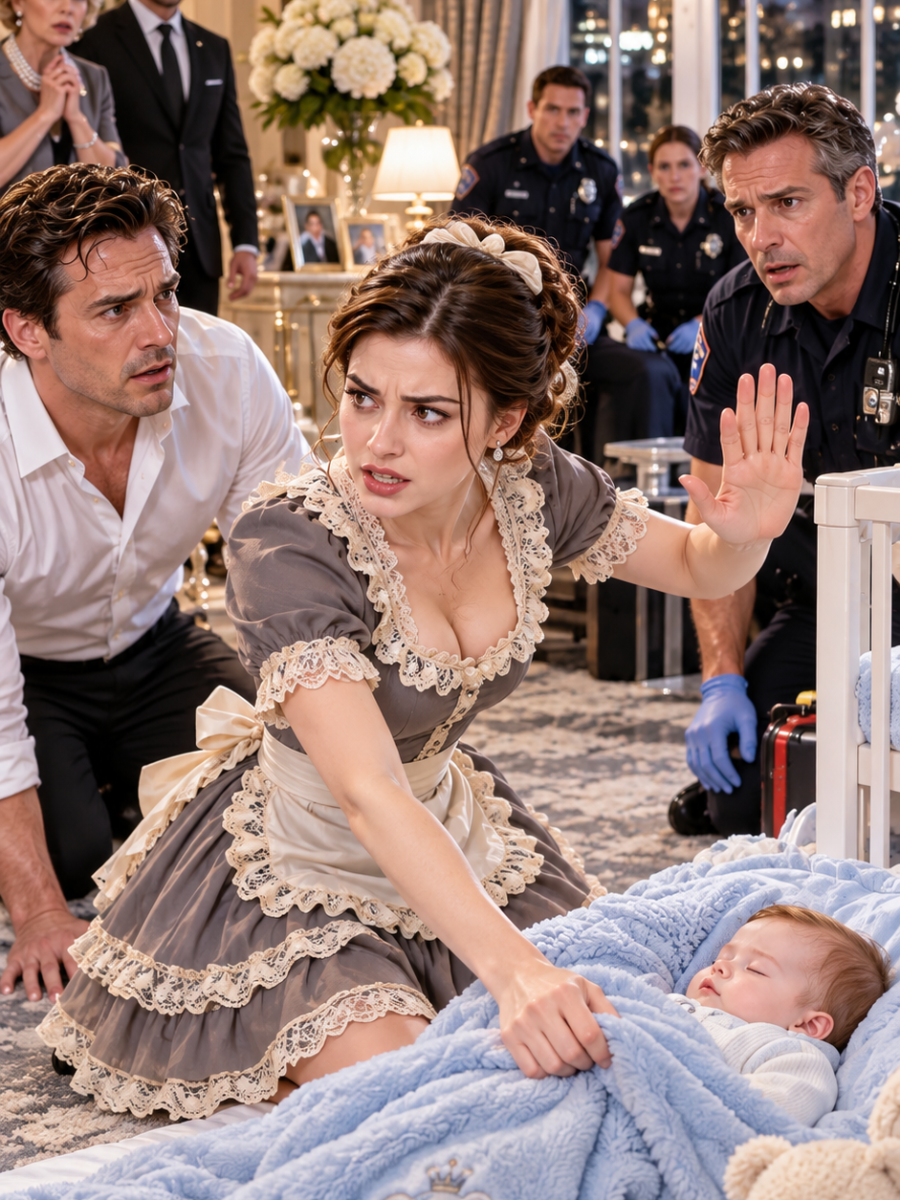
A voice like cracked iron cut through twelve paramedics and four armed guards. Before anyone could react, Emily Parker shoved her way through the doorway and threw herself onto the rug beside Noah.
Emily was our maid. For eight months, she had been a ghost in this house—dark hair tied back in a simple knot, eyes modestly lowered, speaking only in soft courtesies as she folded Egyptian linens and polished silverware. At twenty-three, she had learned that surviving in the home of a ruthless syndicate boss meant becoming invisible.
Not tonight.
The lead paramedic recoiled. “Who the hell are you? Get back!”
“The only person in this room who knows what you’re doing wrong!” Emily snapped with ferocious authority.
“Emily,” I warned, my voice shaking with grief and raw fury. “Step away from my son.”
She ignored me completely. Her gaze swept over Noah’s mottled gray skin, the frothy saliva bubbling at the corner of his lips, the twisted blankets, and the electric heating pads the paramedics had wrapped around his torso. Her eyes narrowed, the pieces of a puzzle slamming together in her mind.
She looked straight at the medics.
“Stop warming him!” she commanded.
The lead medic blinked. “What?! The infant is hypothermic and in full cardiac arrest—”
Emily didn’t argue. With one violent, sweeping motion, she ripped the heavy electric blankets off Noah’s chest, reached into her apron pocket, and produced a steel penlight and a sterile object wrapped in medical gauze. The sudden movement sent every bodyguard’s hand flying to their holsters.
“He’s not in shock from cold,” Emily cried out, thrusting her fingers toward Noah’s throat. “You’re boiling his blood vessels alive—and suffocating him from the inside out!”
↑ Back to Chapter 1
Chapter 2: The Frost on the Infant’s Throat
FRANK TOOK A STEP FORWARD, his weapon half-cleared from leather. “Boss?”
“Hold!” I roared, my instincts overriding the panic that had paralyzed my mind. In Emily’s posture, there wasn’t a trace of malice. There was only the razor-sharp focus of someone fighting for a child’s life.
“Look at his sternum!” Emily shouted at the lead medic, peeling back Noah’s infant onesie. “Look at the hives! That isn’t peripheral mottling from hypothermia—it’s an acute cholinergic angioedema! Your radiant heat is dilating every capillary in his neck, swelling his pharynx until it seals like melted wax!”
The lead medic stared at the child’s chest. Under the harsh halogen lights, faint, raised, crimson wheals were rapidly spreading across Noah’s collarbones—a massive, catastrophic histaminic eruption that the thick blankets had hidden from view.
“My God…” the medic gasped, his face turning pale. “He’s in fulminant anaphylactic shock.”
“And you were baking him alive,” Emily retorted with lethal precision. She didn’t hesitate. Reaching into the ice bucket beside the nursery wet bar—kept chilled for infant formula bottles—she grabbed a linen towel, packed it with crushed ice, and pressed it directly against the anterior triangle of Noah’s swollen throat. “The vasoconstriction will reduce the mucosal edema. Hand me pediatric epinephrine! 0.01 milligrams per kilogram! Lateral thigh, right now!”
The paramedic team, galvanized by the maid’s commands, moved like lightning. The female medic drew 0.06 milligrams of 1:1,000 epinephrine into an insulin syringe, plunged the needle into Noah’s outer thigh, and depressed the plunger. At the same time, Emily held the cold compress firmly against his windpipe, her fingers massaging the tiny airway with surgical dexterity.
Ten seconds passed. The silence in the room was suffocating, broken only by the rain lashing against the glass.
Twenty seconds.
Then, beneath Emily’s icy towel, Noah’s chest gave a sharp, violent convulsion. A high-pitched, whistling rasp echoed through the nursery—the sound of air finally piercing through the opening cords.
Gasp!
On the cardiac monitor, the flat green line suddenly leaped. A jagged spike of electrical activity tore across the screen, followed by another, and another. Sixty beats per minute. Eighty. One hundred and ten. One hundred and thirty.
A loud, indignant, ragged wail tore from Noah’s throat, filling the nursery with the sweetest, most glorious sound I had ever heard in my entire life.
Color flooded back into his cheeks, turning slate blue into rosy pink. His tiny fists flailed in the air, his brown eyes fluttering open as he cried with all the strength of his six-month-old soul.
I collapsed over the changing table, tears streaming unchecked down my face, my trembling hand resting against his tiny chest, feeling the frantic, miraculous thump-thump-thump of his heart. “Noah… Noah, my boy…”
The twelve paramedics stood in stunned disbelief, looking at the young woman in the maid’s apron as though she were a ghost from another world. Emily took two steps back, her hands trembling violently, her chest heaving as the adrenaline drained from her limbs.
I slowly rose to my feet, wiping my face with the sleeve of my shirt. I looked at Emily. “Who are you?”
Before she could answer, her eyes darted toward the silver nursing cart in the corner—where Noah’s unfinished bottle of evening formula sat beside an opened tin of imported powdered milk.
Emily pointed a trembling finger at the bottle. “Noah isn’t allergic to dairy, Mr. Carter. Somebody laced that milk with concentrated peanut lipid peptide—a dose designed to suffocate an infant in four minutes flat.”
↑ Back to Chapter 2
Chapter 3: The Residue on the Silver Spoon
THE CRYING of my son faded into the background as the implications of Emily’s words crashed down upon the room like an avalanche. Frank Miller’s eyes narrowed into slits. With a subtle flick of his hand, two armed security men slid silently in front of the nursery double doors, cutting off every exit.
“Peanut lipid peptide?” the lead medic repeated, picking up the bottle with gloved hands. He unscrewed the plastic ring, sniffing the white liquid cautiously. “It’s odorless. In liquid formula, you’d never detect it without a mass-spectrometer.”
“Look at the rim of the silver measuring spoon,” Emily said, her voice dropping into a tense, analytical rhythm. “There’s an oily, iridescent sheen floating on the surface of the dry powder. Pure infant formula dissolves cleanly into sterile water. Peanut peptide oil separates at room temperature and leaves a faint amber ring on stainless steel.”
I walked over to the changing cart, staring down at the silver spoon. Exactly as she had described, an oily residue clung to the bowl of the metal scoop.
My stomach twisted with murderous fury. Someone had crossed into the most sacred room in my house, stood over my son’s crib, and measured out a chemical compound calibrated to kill an infant while mimicking a sudden, inexplicable crib tragedy.
“How do you know this, Emily?” I asked, my voice deadly quiet. “Housekeepers do not diagnose microscopic lipid separation.”
Emily lowered her head, the confident medical authority slipping away, replaced by the familiar guarded posture of an employee. “Before I came to work for you, Mr. Carter… I was in my final clinical rotation at Tufts University School of Medicine. Pediatric immunology.”
I stared at her in utter astonishment. “You were a medical student?”
“I had ninety credits toward my medical degree,” she whispered, her voice laced with an old, deeply buried grief. “Top three percent of my class.”
“Then what the hell are you doing dusting chandeliers in my North Shore mansion?”
She took a shuddering breath. “Because two years ago, my eight-year-old brother, Leo, went into severe anaphylaxis at an elite private summer camp in the Berkshires. The camp director delayed calling emergency services for forty minutes to protect their reputation. When Leo finally reached the private clinic, the attending physician refused to administer advanced resuscitation because our family’s insurance had lapsed.”
Her hands clenched into tight fists against her apron. “My brother suffered irreversible anoxic brain damage and passed away three days later. When I tried to file a wrongful death suit against the clinic and its parent pharmaceutical conglomerate, they used their legal apparatus to revoke my academic scholarship, blacklisted my medical board credentials, and sued my mother for defamation until we lost our home.”
A cold dread pooled in my gut. “What was the name of the pharmaceutical conglomerate that owned that clinic, Emily?”
Emily looked directly into my eyes, her jaw set like stone: “Aegis Biopharma. Owned and operated by Julian Thorne.”
↑ Back to Chapter 3
Chapter 4: Two Hundred Thousand Dollars in the Nursery
JULIAN THORNE. The name was like a brand of fire across my mind. Thorne was the undisputed king of New England’s illicit offshore pharmaceutical networks—a ruthless billionaire competitor who had spent three years fighting me for control of the Boston container terminals. Last month, my maritime logistics firm had officially outbid Thorne for the South Boston shipping leases, locking his synthetic narcotics pipelines out of North America for the next twenty years.
He had sworn he would take what was dearest to me.
I slowly turned around, my gaze scanning the nursery until it locked onto Margaret Collins. The fifty-five-year-old night nanny was still huddled near the mahogany armoire, clutching a lace handkerchief, her shoulders trembling with theatrical sobs.
“Margaret,” I said, the word coming out softer than a whisper, yet carrying the weight of a guillotine blade.
She flinched, lowering the handkerchief. “Mr. Carter… it’s a miracle… thank God Miss Emily noticed… I don’t know how that awful substance got into the canister—”
“Who prepared Noah’s evening bottle at 7:45 PM?” I asked, stepping toward her.
“I… I did, sir. But I used the sealed tin from the pantry! I swear on my mother’s grave, I never saw any oil!”
“Frank,” I commanded without breaking eye contact with the trembling nanny. “Search her quarters. Search her vehicle in the staff garage. And pull her bank statements from the offshore terminal in the study.”
“No! Please!” Margaret shrieked, her veneer of motherly innocence shattering in an instant. She lunged toward the doorway, but Frank’s massive arm caught her by the collar, slamming her back against the armoire with enough force to shake the crystal knobs. Frank reached into Margaret’s heavy wool coat hanging behind the nursery door, his gloved hand reaching into the deep interior lining.
He pulled out an unsealed manila envelope and a high-security European burner phone.
Inside the envelope lay a cashier’s check drawn from an offshore bank in Grand Cayman for two hundred thousand dollars, made out directly to Margaret Collins. Attached to the check was a printed flight itinerary for an 11:30 PM red-eye departure from Logan International Airport to Zurich.
And sitting in the bottom of her purse was a small glass vial containing five milliliters of viscous, amber-tinted liquid.
“You poisoned my son,” I said, every nerve in my body turning to ice as I looked at the woman who had rocked Noah to sleep for six months. “You were paid two hundred thousand dollars to suffocate a baby in his crib, and then you were going to board a plane to Switzerland while I buried him.”
Margaret fell to her knees on the Persian rug, clutching my trouser leg, tears of pure terror pouring down her wrinkled face. “Thorne swore the child wouldn’t suffer! He said it would look like sudden crib death! He threatened my daughter’s mortgage, Mr. Carter! He said if I didn’t pour the vial into the formula, his men would burn her house with her children inside!”
I kicked her hands away from my shoes, repulsed to the core of my being. “Frank. Take her down to the harbor cellar. Keep her alive until our federal contacts arrive.”
“And Julian Thorne, boss?” Frank asked, his eyes gleaming with lethal anticipation.
I glanced at the flight itinerary in Frank’s hand. “Thorne is waiting for Margaret at his private yacht slip in Boston Harbor. He thinks he’s celebrating a funeral tonight. Let’s make sure he doesn’t leave the dock.”
↑ Back to Chapter 4
Chapter 5: The Medical Student in the Linen Room
WITHIN THIRTY MINUTES, our private medical transport had safely secured Noah inside the sterile isolation wing of Massachusetts General Hospital under the direct personal supervision of the Chief of Pediatric Critical Care. Four of my most trusted armed soldiers stood guard outside his glass door. My son was breathing effortlessly, sleeping peacefully with a pacifier in his mouth, completely unaware of how close he had danced with the abyss.
I returned to the North Shore mansion at 1:00 AM. The rain had settled into a thick, creeping Atlantic fog that veiled the coastal cliffs in silver mist.
I walked down the long east hallway toward the staff quarters. The door to the linen storage room was slightly ajar. Inside, sitting on a wooden bench beneath a single bare bulb, was Emily Parker. She had changed out of her formula-stained uniform into an oversized cable-knit sweater and worn denim jeans. In her lap lay a tattered medical textbook: Nelson Textbook of Pediatrics, 21st Edition.
Her fingers were tracing the anatomical diagram of an infant’s respiratory tract, tears silently rolling down her pale cheeks.
I gently pushed the door open. “Emily.”
She startled, quickly snapping the heavy textbook shut and wiping her eyes with the sleeve of her sweater. “Mr. Carter… I’m sorry. I was just gathering my personal belongings. I know… after what happened tonight, you won’t want someone with a complicated past in your household. I can have my trunk packed in twenty minutes.”
I looked at the girl who had stared down twelve paramedics, defied my orders, and breathed life back into my dying son. A lump rose in my throat that had nothing to do with power or money.
I walked into the small room and sat down on the wooden bench beside her. For a long moment, neither of us spoke. Only the distant foghorns of the Atlantic broke the quiet.
“You saved my world tonight, Emily,” I said softly.
Her lower lip trembled. “I just… when I saw Noah’s neck, all I could see was Leo’s face two years ago. The doctors stood around my brother with their hands in their pockets because our health insurance had lapsed. They let him choke on his own tongue, Mr. Carter. I swore to God on Leo’s grave that if I ever saw another child in that darkness, I would tear the walls down before I let them die.”
A profound, humbling warmth spread through my chest. For years, I had believed that strength was defined by violence, by the fear I could command in boardrooms and across the shipping piers. But sitting beside this twenty-three-year-old woman who had lost everything yet retained the courage of an angel, I understood what real strength looked like.
“You’re not packing any trunk,” I told her firmly. “Tomorrow morning, the legal counsel of the Carter Foundation will file an emergency petition with the Massachusetts Medical Board. Your academic credits will be restored in full. The Carter Endowment at Harvard Medical School will sponsor your final year of medical training, your residency, and your pediatric fellowship.”
Emily gasped, her hands flying to her mouth, her eyes wide with shock. “Mr. Carter… no… that costs hundreds of thousands of dollars—I can’t possibly accept—”
“You gave me my son’s heartbeat,” I interrupted, taking her small, trembling hands into my scarred palms. “There isn’t enough gold in the United States Treasury to pay what I owe you. But first, there is one piece of unfinished business in Boston Harbor.”
Frank stepped into the doorway, his coat dripping with fog: “Boss. Thorne’s yacht just fired up its diesel engines at Pier 44. He’s preparing to slip his moorings.”
↑ Back to Chapter 5
Chapter 6: The Interception at Boston Harbor
PIER 44 SMELLED of salt water, diesel exhaust, and wet cedar. A hundred-and-forty-foot luxury yacht named The Sovereign hummed against its mooring lines, twin diesel exhausts chuffing white vapor into the freezing Atlantic fog.
On the upper deck stood Julian Thorne, wrapped in an expensive camel-hair coat, swirling a snifter of vintage cognac. He checked his gold Rolex, looking down at the empty pier. “Where is Margaret?” he barked at his head of security. “Her flight leaves in thirty minutes. She was supposed to deliver the confirmation photographs of the Carter nursery before midnight.”
“Her phone is switched off, sir,” the bodyguard replied nervously. “We should untie the lines. The port authority clearance is already filed.”
“Fine,” Thorne sneered, taking a sip of cognac. “Michael Carter is currently weeping over a dead infant. By tomorrow morning, the North Shore territory will be ours for the taking. Cast off—”
The sudden shriek of high-intensity maritime searchlights cut through the fog like twin laser blades, blinding everyone on the yacht’s deck.
Four heavy steel tugboats, flying the black-and-gold flag of Carter Maritime, surged out of the gloom, boxing The Sovereign against the concrete seawall with the crushing force of five thousand horsepower. At the same time, three black SUVs screeched to a halt at the head of the pier, their doors flying open in unison.
Twenty armed Carter enforcers fanned out along the slip, their automatic rifles trained directly onto the yacht’s bridge.
Thorne dropped his glass. The crystal snifter shattered against the teak deck, spilling dark cognac across his polished shoes. “Carter?!”
I walked down the gangway into the glaring white beam of the searchlights. I wore a tailored black overcoat, my hands resting calmly inside my pockets. Walking a pace behind me was Frank Miller, holding Margaret Collins by her handcuffed wrists, her face swollen with tears.
Beside Frank walked Special Agent Daniel Vance of the Federal Bureau of Investigation, flanked by six tactical agents in full body armor.
“Good evening, Julian,” I called out, my deep voice booming across the water with the absolute authority of an executioner. “You forgot to check the guest list for your victory cruise.”
Thorne backed toward the saloon doors, his arrogant facade cracking into hysterical panic. “You have no right to block my vessel! I’m an American citizen departing on international business! Captain, full reverse! RAM THOSE TUGS!”
“The captain isn’t moving an inch, Julian,” I smiled, cold as the Atlantic ice. “Because fifteen minutes ago, Carter Maritime bought this pier, this yacht… and your freedom.”
↑ Back to Chapter 6
Chapter 7: Midnight Justice on the Pier
TWO SHARP CLICKS echoed across the water as the yacht’s twin diesel engines were killed from the bridge. The captain and three crew members emerged onto the bow with their hands resting on their heads.
“Traitors!” Thorne screamed, lunging for the rail. “I pay your salaries!”
“Not anymore,” Agent Vance announced through an amplified megaphone. “Julian Thorne, step down the gangway with your hands in plain view. Pursuant to Title 18 of the United States Code, you are under arrest for conspiracy to commit murder, corporate sabotage, interstate distribution of controlled lethal peptides, and federal racketeering.”
Thorne’s private security dropped their weapons onto the deck, kicking them toward the gunwales. Federal agents swarmed the yacht, forcing Thorne to his knees against the cold metal grating of the gangway. Steel handcuffs ratcheted around his wrists with a sharp, final click.
As they dragged Thorne past me toward the awaiting federal transport, the billionaire turned his venomous glare toward my face. “You think you won, Carter?! You’re a criminal just like me! Your brat got lucky!”
I stepped directly into his path, forcing the agents to halt. At six-foot-three, I looked down at the man who had ordered my six-month-old child’s murder for corporate market share.
“Noah didn’t get lucky, Julian,” I said, my voice low and terrifyingly steady. “He was saved by the sister of a little boy named Leo Parker—the eight-year-old child your private clinic murdered two years ago in the Berkshires.”
Thorne’s eyes dilated in sheer, unadulterated horror. The blood drained from his face as the ghost of his past sins rose up to drag him into darkness. “No… that’s impossible… that was settled out of court—”
“The universe has a way of settling debts that your lawyers couldn’t erase,” I whispered. “You took her brother’s breath. And tonight, she took your entire empire.”
As the federal convoy sped away into the night with sirens wailing, Frank handed me an encrypted tablet containing the seizure confirmation: the Department of Justice and the Massachusetts Attorney General had frozen every asset belonging to Aegis Biopharma. By morning, Julian Thorne would be an inmate in a federal holding facility, facing consecutive life sentences without parole.
I turned my back on the dark water of Boston Harbor. The night of horrors was over.
“Frank,” I said, climbing into the SUV. “Take me to Massachusetts General Hospital. My son is waiting for his father.”
↑ Back to Chapter 7
Chapter 8: Sunrise Over the Atlantic
ONE YEAR LATER, a brilliant golden sunrise spilled across the Atlantic, illuminating the grand rose gardens and limestone terraces of the Carter North Shore estate.
The dark shadows that had once haunted the mansion were gone. The nursery had been completely renovated into a sun-drenched playroom filled with wooden blocks, stuffed animals, and children’s laughter. Over the past twelve months, the Carter Foundation had established the Leo Parker Pediatric Critical Care Pavilion at Boston Children’s Hospital, providing free advanced allergy and immunology treatment to thousands of underprivileged children across New England.
I sat on the seaside terrace, drinking black coffee, watching the gentle tide roll against the rocky shore.
Suddenly, the glass patio doors slid open, and the pitter-patter of energetic little footsteps came running across the stone flags. Noah, now a sturdy, laughing eighteen-month-old toddler with curls of golden-brown hair, raced toward me, clutching a plush blue whale in his chubby hands.
“Dada!” he shrieked with joyful abandon, launching himself straight into my open arms.
I scooped him up, swinging him high into the salt-scented air as his bright, melodic giggles echoed across the terrace. I pressed my face into his soft neck, breathing in the scent of baby soap and pure life. Every time I held him, the memory of that terrifying flatline served as a solemn reminder of how fragile, and how precious, this miracle was.
Walking onto the terrace behind him was Emily Parker.
She wore a pristine white lab coat embroidered with dark blue lettering: Dr. Emily Parker, MD — Department of Pediatric Immunology. Having completed her final clinical credits with honors, she was now the lead clinical research fellow at the Leo Parker Pavilion. Her dark hair was styled with effortless elegance, and her hazel eyes radiated confidence, peace, and the warmth of a woman who had reclaimed her rightful destiny.
“Mimi!” Noah squealed, squirming in my arms until Emily reached out and playfully booped his little nose.
“Good morning, little troublemaker,” Emily laughed, kissing his cheek before turning to me with a brilliant smile. “The ethics board just approved our clinical trial for rapid-acting sublingual peptide antagonists. We begin patient enrollment next Monday, Michael.”
I smiled—a deep, genuine smile that reached my eyes—and reached for her hand, gently interlacing my fingers with hers. “Leo would be so proud of you, Emily.”
Emily looked out over the sparkling Atlantic waves, a peaceful, grateful tear shining in her eye. She squeezed my hand, leaning gently against my shoulder as Noah happily babbled between us.
For twenty years, I had ruled this city with cold steel and ruthless authority, believing that power was the only shield against the cruelty of the world. But looking at my thriving son and the extraordinary woman standing beside me, I knew the truth.
True power wasn’t the ability to take a life. It was the fierce, unyielding love that had the courage to bring one back from the dark.
↑ Back to Chapter 8
You Might Also Enjoy These Viral Sagas
“Who Made You Cry?”
A feared Chicago mob boss notices red finger bruises around his quiet waitress’s wrist—and teaches a corrupt senator the true cost of extortion.
The Bruise Beneath the Dark Hair
At thirty-nine, mafia king Luca Moretti watches his housemaid serve dinner with hair covering her face—until his fiancée blurted out an excuse before he even asked what happened.
Bad Lady Put Sleepy Powder!
A two-year-old girl in a sparkling red princess dress knocks over a mafia boss’s coffee, hands him a photograph of his fiancé with his father’s murderer, and points to a bomb counting down from nineteen seconds.